Sunday, March 21, 2010
My garlic is up!
Monday, March 15, 2010
This year's vegetable garden: the seeds and plants
To date, I have done this in a pretty haphazard manner. For seeds, I go to a large nursery where I live, armed with a list of vegetables I want to grow and a "Recommended Vegetable Cultivars for Maryland Home Gardens" printout. This works great if the recommended cultivars are in stock, but about half the time they aren't. And since I am buying my seeds at such a late date, I don't have time to order any, so I just end up randomly grabbing some seeds and hoping for the best. Actually, so far, this method has worked out pretty well for me.
But it does not work if you have heart set on something specific. And, as I learn more about gardening, I am starting to get more interested in specific varietals. So, if I want a specific seed, I will need to order it. But where from?
A friend of mine recommended Pinetree Garden Seeds. I have the catalog in front of me and although the organization is a little strange (it has separate sections for "Italian vegetables", "French vegetables" etc., there are good descriptions.
Another catalog that comes well recommended is Fedco. I like that they don't sell genetically modified seeds. But the catalog - at least online - is a bit intimating.
I think Fedco will need to wait until next year. I need to hurry up and get my seeds ordered!
Saturday, March 6, 2010
This year's vegetable garden: the plan
This will be the third year of my formal (meaning not just in pots) vegetable garden. Before that, despite the size of my yard, I only did a few tomatoes, eggplants, and peppers in pots. Then, in 2008, I started my first 4x4 square foot garden. That first year, I grew spinach, chard, lettuce (leaf and head), tomatoes, cucumbers, peppers and eggplant. I was amazed at how much food I was able to grow in 16 square feet and decided to double my garden.
In 2009, I grew all of the vegetables above (and more of some) and also tried green beans, radishes, carrots, jalepenos, bok choy, butternut squash and pumpkin (a volunteer that I allowed to stay). Again, a successful year, despite a late-arriving late blight.
So this year, I am sticking with my 32 square feet and trying to decide what to plant. Because I plant in such a small space, I try to get two crops out of a single space. This year, I would like to add to my garden:
- Tomatillo
- Cabbage
- Turnips or rutabaga
- Lemon grass
I might replace the butternut squash with delicata, plan to have less green beans and won't keep any volunteer pumpkins. It is still a lot of plants for a small space. But I think it will work.
What do you have planned for your vegetable garden?
Sunday, February 21, 2010
Garden Project: The Berm
The other problem in my yard was the view of the neighbor's trampoline. They kindly placed this right at the edge of their yard so that it is visible from my deck and almost every window on the back of my house. Fortunately, their kids never used it that much, but it is a huge eyesore.
So, I thought - why don't I pay someone to move the rock to the edge of the yard, put some more dirt on top of it, and create a berm that I could then plant and block the ugly view from the neighbor's yard. Great idea, but it has not worked out the way I planned.
First, I was expecting the rock on the bottom, the dirt on the top. Nope - the rock is mixed in with the dirt, making it a huge pain to plant things. Second, the dirt was full of weeds, and several years later, I am still dealing with this. Third, it doesn't really block the view of the trampoline - in some ways it accentuates it. We have created this focal point, that, at certain times of year, looks rather pretty, despite all of its problems. And unfortunately, the bushes on the berm are not tall enough (and not going to get tall enough) to block the trampoline. So instead of hiding it, I am now drawing attention to it!
(As a side note, the nieghbor's youngest child has just started college. Isn't it time to put the trampoline away? Please?)
The berm is 44 ft long. Most of it (and all of the problem area) is in full sun. About half the berm is planted with native grasses, bushes, trees, etc. It may not look perfect, but it works pretty well. The other half is planted with some pyracantha and black-eyed Susans. I picked the pyracantha because I wanted something evergreen and deer resistant. It is both, but it is too short and too sparse to hide anything. The black-eyed Susans look nice from a distance, but are being crowded by tons of weeds. Every year it gets a bit worse and is almost to the point where I should kill everything and start over.
Although the black-eyed Susans look great in the late summer, I think one of the problems with growing them by themselves is that they come up a bit late and the weeds get a headstart on them. To try to address this, I am going to plant several other perennials that bloom (and so hopefully come up) earlier, and presumably will help crowd out the weeds. The plants I have picked are all native, meadow type plants.
They are:
- Common milkweed (asclepias syriaca) -purple blooms May - August
- Butterfly weed (asclepias tuberosa) - orange blooms May - July
- Wild blue indigo (baptista australis) - blue blooms May - June
As for the pyracantha, my current plan is to leave it alone and plant additional bushes behind it (on the backside of the berm). The bushes have to be deer resistant, and I would prefer that they are native and evergreen. This narrows my options - a lot. The one criteria I am most willing to give on is evergreen.
I have narrowed my list to four possibilities:
- Silky Dogwood (cornus amomum) - grows 6-12 feet high, white flowers in spring, berries in August, good fall color (not evergreen)
- Inkberry (ilex glabra) - 6-10 feet high, evergreen, black berries, need both male and female plants
- Southern bayberry (morella cerifera) - 6-15 feet high, semi-evergreen, but probably not evergreen in my area
- Scrub oak (quercus ilicifolia) - 12-20 feet high, leaves persist into winter (holds dead leaves), good fall color
The last option is not a bush, but a small tree. All have good wildlife value. The bayberry is probably the least visually interesting, but probably the easiest to find. I like the idea of planting more oaks in my yard for their incredible wildlife value, but I am concerned that these trees will get too large for the area. If I had to guess now, I think I am going to end up with either the inkberry or the dogwood. Or maybe both? I need to figure out just how many of them I need.
Thursday, February 11, 2010
Snowmegeddon: The Garden Damage
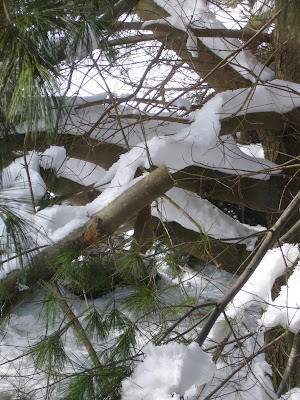
Then, I saw the damage to my white pines (cue the Psycho music). My white pines lost some major limbs! Now I can see my neighbor's swing set! AGHHH!
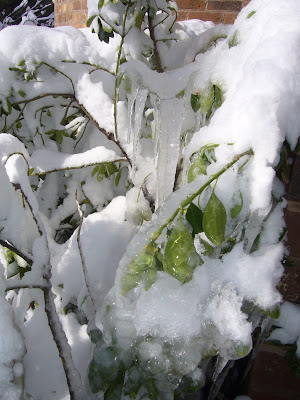
Okay, snap out of it. Many people had a lot worse damage than I did. The full extent of the damage in my yard will not be evident until the snow melts but as of right now, most of the damage seems to have been sustained by evergreens that were weighted down by snow and ice. Some, like a cypress, was on the decline before this happened. A few of the bushes I always thought were ugly anyway, so they won't be missed. And some will no doubt recover, like my ice covered euonymus (For those paying close attention, these are different euonymus than the ones with crown gall that I blogged about last week. The former owners loved euonymus!). Unfortunately, there is a also large evergreen near my driveway that lost several limbs, and I am not sure if it can be saved.
Saturday, February 6, 2010
Garden Projects for 2010
In the past, my eyes have always been bigger than my spade (is that how the saying goes?) and so don’t hold me to actually completing all (or maybe even any) of these. With that caveat, here are my top projects for 2010:
Project 1 – Plant a hedgerow. I want to plant a row of fruiting bushes that will attract birds and provide me some blueberries. The area is about 50 feet long and, theoretically, as wide as I want it to be. The wider I make, the less lawn there is to mow!
Project 2 – Replant my front walkway. The previous owners planted variegated euonymus (I know, I know) along the walk. But, for the first few years, it looked decent, so I focused my attentions elsewhere. Then, a couple of years ago, the plants started dying. It turns out, they have crown gall. Basically the only cure is to remove the plants and plant something resistant to crown gall. Have not yet decided what that would be.
Project 3 – Fix my berm. Several years ago, I had a berm made out of some excess soil and rock that I had (long story). My hope for the berm was that it would create a beautiful view for me to look at when I am standing at the sink. At certain times of the year, it serves that purpose, but often, it is just a weedy mess. Want to try to get this under control. Have not yet decided exactly how that is going to be accomplished.
Project 4 – Plant an oak. Although I have a number of mature trees in my yard, none are oak. Now that I understand how valuable oaks are to wildlife, I want to have at least one. But oaks grow big, so you need to make sure that you plant it in the right spot. Theoretically, this should be the easiest of the four projects, but my analysis paralysis may hit me on this one, since once placed, I will not be able to easily move the tree.
Of course, I will continue my vegetable garden this year, but since I have no plans to expand it, it is not on the list of projects.
I hope to use this blog to think through the specifics of each of these projects. I would love any and all feedback, words of advice, etc.
Wednesday, February 3, 2010
Dinners from the Winter Farmers Market
First, we made a savoy cabbage gratin from Vegetarian Suppers from Deborah Madison’s Kitchen (a wonderful vegetarian cookbook). I have just started making gratins (in December I made a swiss chard and sweet potato gratin from Smitten Kitchen). Unfortunately, I have fallen in love with these rich, creamy dishes. Although packed with vegetables, I am afraid they are also loaded with calories.
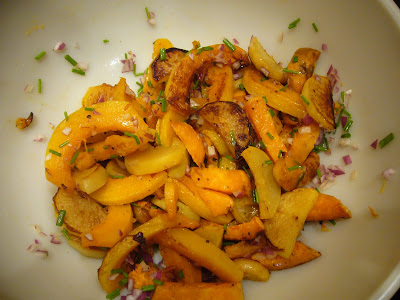
With the gratin, we had medley of roasted autumn vegetables. This too was terrific. It was a pretty dish, easy to make, and had lots of interesting flavors. The addition of the vinegar, onion, and chives at the end made it go from good to great!
The gratin only used half of the cabbage, so I had to figure out what to do with the rest. I had made cabbage soup only about a week ago, so that was out. Then I found a recipe for Moo Shu Pork on the Cooking Light website. Although the recipe calls for napa cabbage, the savoy worked great. Mr. 2GA raved about this recipe. It is healthy and easy to make, so we will be having it again before too long.
Not all of our dishes were smash hits. The braised turnips with poppy seed breadcrumbs were edible, but not nearly as good as we had hoped. And not good enough for a picture apparently, because I forgot to take one.
I have always liked winter vegetables, but having all of these veggies in the house at once really encouraged me to try new ways of fixing them. Do you have any favorite recipes for winter vegetables? If so, please share them!
One last note - my sad pumpkin soup made the "Grow Your Own" roundup over at House of Annie. Check it out!