I love to think about garden projects, love to plan garden projects. Love, love, LOVE.
Especially in winter.
Is there anything better than sitting down with a bunch of gardening books, a computer, and a garden notebook? Researching plants, looking up pictures, sketching out plans, cross referencing height, water requirements, deer resistance, etc?
I love this so much that my husband will tease me that I like to think about gardening more than I actually like to garden. Sometimes I think he might be right.
But the other reason I spend so much time on planning is that I have such a hard time making choices about the garden. Should I put a row of blueberries here? Or would river birch look better? Or maybe this area should be incorporated into the meadow I am thinking about (key word: thinking!). By deciding on one option, I have to reject all the others. And for me, that is hard to do!
Another problem I have is that sometime I over plan. I develop a plan that includes every plant I need, down to the varietal. Then, if I cannot find these exact plants, the whole plan falls apart and I start all over. It is a wonder I ever get anything planted.
I don't have this problem in the vegetable garden, for a couple of reasons. First, I am not making a long term commitment to anything - I only have to live with the plants for a year. And as important, if I don't make a decision by a certain date, I lose my opportunity to grow vegetables. So, while I may dither a bit about the exact plants in the vegetable garden, in the end, it does get planted each year.
It is the more permanent plants that cause me the most anxiety. Right now, I am in full planning mode for spring planting and I am trying something a little different which I hope will make it easier for me to actually get something in the ground. When looking at how to plant an area, I am trying to find a few alternatives that would work well for the site. So, if I need some medium (3-5) bushes that work in a sunny, dry spot in my yard, I am trying not to get caught up in the one "best" bush, but instead to find 2 or 3 that I like so that I might have more luck actually finding one. I will let you know how it turns out.
Do you have any tricks to help you move from planning to action? I would appreciate any advice!
Tuesday, January 12, 2010

Wednesday, January 6, 2010
A not so great garden pumpkin soup
This year we had a volunteer pumpkin plant that we let grow. It produced those small pumpkins that people use for decorating. We harvested about a dozen of them and had them all around the house for some nice fall decoration.
It seemed sort of silly to just throw them out when we were done with them, but I didn't want to throw them in the compost since that is how I got the volunteer in the first place. So I started looking around for pumpkin recipes. I have never really been a fan of pumpkin, but I thought I should give it a try. I finally decided on a soup recipe from Epicurious that looked easy and got good reviews.
The first problem was that there was very little "meat" on these pumpkins. As a result, I was perhaps not as vigilant in pulling out all the stringy stuff for fear I wouldn't have anything left.
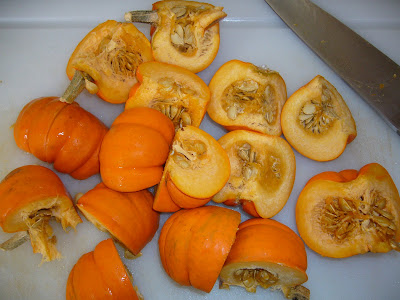
Although the recipe did not specifically call for roasted the pumpkin, I decided to do so because I was concerned that these might not be the most flavorful pumpkins in the world and that roasting would help. I also decided to roast the seeds while I was at it.
Once done, I scooped out all of the pumpkin and made the soup. It was a disappointing mess. The flavor was okay, but the consistency was stringy which I really did not care for. Mr. 2 Green Acres actually liked the soup (and yes, I think he really meant it), but I won't be making that again.
The pumpkin seeds were fine, but they are miniature, just like the pumpkins, so they are a bit of a pain to eat. All in all, a bit of a bust. But at least I tried, right?
I still have more pumpkins and have an interesting recipe for cheese stuffed pumpkins. But I am not commited to making it. I think I might be done with the pumpkin thing.
It seemed sort of silly to just throw them out when we were done with them, but I didn't want to throw them in the compost since that is how I got the volunteer in the first place. So I started looking around for pumpkin recipes. I have never really been a fan of pumpkin, but I thought I should give it a try. I finally decided on a soup recipe from Epicurious that looked easy and got good reviews.
The first problem was that there was very little "meat" on these pumpkins. As a result, I was perhaps not as vigilant in pulling out all the stringy stuff for fear I wouldn't have anything left.
Although the recipe did not specifically call for roasted the pumpkin, I decided to do so because I was concerned that these might not be the most flavorful pumpkins in the world and that roasting would help. I also decided to roast the seeds while I was at it.
Once done, I scooped out all of the pumpkin and made the soup. It was a disappointing mess. The flavor was okay, but the consistency was stringy which I really did not care for. Mr. 2 Green Acres actually liked the soup (and yes, I think he really meant it), but I won't be making that again.
The pumpkin seeds were fine, but they are miniature, just like the pumpkins, so they are a bit of a pain to eat. All in all, a bit of a bust. But at least I tried, right?
I still have more pumpkins and have an interesting recipe for cheese stuffed pumpkins. But I am not commited to making it. I think I might be done with the pumpkin thing.
Sunday, December 20, 2009
Native Plant of the Month: Winterberry

When most plants have hunkered down to wait out winter, winterberry (ilex verticillata) continues to put on a show. Unlike most hollies, winterberry is decidious. When it loses its leaves in later winter, all that remains are its beautiful red berries.
In addition to being a cheerful bright spot in the winter landscape, these berries serve as a great source of food for song birds in the winter months.

If you are interested in adding a winterberry to your garden, be sure to buy at least two - a male and a female. You only need one male plant for many females, but it should be within 50 feet of the females to ensure good berry production.

This holly is native to the eastern half of the U.S., prefers moist, acidic soil, and grows in sun to partial shade. Winterberry bushes can get up to 10 feet tall and wide, but there are a number of varietals in all sizes. For more information on this great plant for winter interest, check out this website.
You might also like:
November native plant of the month: Doll's Eyes
October native plant of the month: Sugar Maple
September native plant of the month: Blueberry
August native plant of the month: Joe Pye Weed
Photo credit: Muffet
Friday, December 11, 2009
Gifts for Gardeners: Beyond books
For the final installment of my gardener gift guide, I want to highlight some gift ideas for gardeners beyond books (for books, see gift guides part 1 and part 2).
1. Rain barrel - Okay, you might want to be cautious with this one. Some people react to a rain barrel the same way they would react to a vacuum under the Christmas tree. But for the right person, this is a great gift. There are lots of different rain barrels you can buy, but they are also pretty easy to make if you are handy.
2. Bluebird house - Help reintroduce bluebirds into your neighborhood with a bluebird house. Or, if you are more interested in other birds, check out this great resource guide from the National Audubon Society.
3. Gardening gloves - Most gardeners can use a new pair of gardening gloves, and I particularly like these. With other gloves, I often end up taking them off when I am trying to do delicate work, but with these, I have sufficient dexterity so I don't need to remove them. I also like how the protect from prickers, but don't make your hands hot.
4. Garden spade - Maybe it is just me, but I used to go through garden spades at a rapid rate. I get a little over-enthusiastic with my use of the spade and end up bending the shaft. My husband got me this spade when I became a Master Gardener (awwww), and I have used it for several years now and no bending!
5. Garden pruners - Every gardener needs good pruners. If you don't have some, put these on your list. The ones I have are an older version, but I love them - had them for years and they are still sharp, still work great.
I hope this gift list has been helpful. I would love to hear about what is on your list; what I have missed.
1. Rain barrel - Okay, you might want to be cautious with this one. Some people react to a rain barrel the same way they would react to a vacuum under the Christmas tree. But for the right person, this is a great gift. There are lots of different rain barrels you can buy, but they are also pretty easy to make if you are handy.
2. Bluebird house - Help reintroduce bluebirds into your neighborhood with a bluebird house. Or, if you are more interested in other birds, check out this great resource guide from the National Audubon Society.
3. Gardening gloves - Most gardeners can use a new pair of gardening gloves, and I particularly like these. With other gloves, I often end up taking them off when I am trying to do delicate work, but with these, I have sufficient dexterity so I don't need to remove them. I also like how the protect from prickers, but don't make your hands hot.
4. Garden spade - Maybe it is just me, but I used to go through garden spades at a rapid rate. I get a little over-enthusiastic with my use of the spade and end up bending the shaft. My husband got me this spade when I became a Master Gardener (awwww), and I have used it for several years now and no bending!
5. Garden pruners - Every gardener needs good pruners. If you don't have some, put these on your list. The ones I have are an older version, but I love them - had them for years and they are still sharp, still work great.
I hope this gift list has been helpful. I would love to hear about what is on your list; what I have missed.
Sunday, December 6, 2009


Thursday, December 3, 2009
Gifts for gardeners: Books (part 2)
Earlier, I focused on books for gardeners interested in native plants. In this post, I will focus on books for gardeners interested in vegetable gardening and local food.
1. All New Square Foot Gardening by Mel Bartholomew. I have to admit it - this is the only book on vegetable gardening that I own. For begining vegetable gardeners, this is a great book. It provides step by step instructions on how to create a vegetable garden that has few weeds and a lot of produce per square foot. My husband and I refer to this book as the "bible".
2. Ominvore's Dilemma by Michael Pollan. If you aren't convinced of the benefits of eating locally grown food, this book will convince you. And if you are already a convert, this book will provide new information about industrial food production and the benefits of eating locally.
1. All New Square Foot Gardening by Mel Bartholomew. I have to admit it - this is the only book on vegetable gardening that I own. For begining vegetable gardeners, this is a great book. It provides step by step instructions on how to create a vegetable garden that has few weeds and a lot of produce per square foot. My husband and I refer to this book as the "bible".
2. Ominvore's Dilemma by Michael Pollan. If you aren't convinced of the benefits of eating locally grown food, this book will convince you. And if you are already a convert, this book will provide new information about industrial food production and the benefits of eating locally.
3. Animal, Vegetable, Miracle by Barbara Kingsolver and Plenty by Alisa Smith and J. B. Mackinnon. These two book cover somewhat the same territory. In both, the authors try to live for a year eating only local food. In the Kingsolver book, her family raises a good portion of their food. In Plenty, an urban couple in Vancouver tries to source all of their food within 100 miles of their house. I was inspired by both of these books.
4. Fresh Food Fast by Peter Berley and Vegetarian Suppers by Deborah Madison. Once you grow - or buy - all of these vegetables, you need to know how to cook them. These are both great cookbooks for cooking seasonal vegetables. I am not a vegetarian, but I love these vegetarian cook books.
5. Food Matters by Mark Bittman. I have not read this one, but it is on my list. This is a mix of The Omnivore's Dilemma and a cookbook. Mark Bittman is a food writer for the New York Times, and in this book, mixes his own personal food conversion (and weight loss) with recipes.
What have I missed? What books on local food or vegetable gardening do you refer to again and again?
Tuesday, December 1, 2009
Gifts for gardeners: Books (part 1)
With the holidays just around the corner, I thought I would share some of my favorite gardening books (and a few I hope to see under the tree this year).
This list is focused on native gardening. I will post another list focused on vegetable gardening and local food.
1. Noah's Garden and Planting Noah's Garden, by Sara Stein. Noah's Garden is the first book I read that really got me thinking about native plants, their role in the local environment, and their potential role in my yard. Planting Noah's Garden takes the concepts in the first book and gives you practical advice on how to plant a meadow, build a bird house, etc. I refer back to both of these books constantly, to get both inspiration and ideas.
2. Bringing Nature Home by Douglas Tallamy. I got this book last year for Christmas and it really opened my eyes to the incredible importance of native plants for our local wildlife. Where Sara Stein is an enthusiastic and knowledgeable lay person, Douglas Tallamy is an entomologist and has a vast understanding about how insects rely on native plants for food, and birds and small mammals rely on insects as a food source, so if we don't feed the insects, the whole food chain collapses. This book includes lists of which plant feed the widest variety of insects and so are most useful in the landscape.
All three of the above books are incredibly readable, but they are not filled with glossy photos like many garden books. If that is what you are looking for, I recommend:
3. Natives Trees, Shrubs and Vines, by William Cullina. This book contains beautiful photos and wonderful descriptions of plants native to the U.S. The author writes in a very conversational style and his passion for native plants shines through. The book also includes helpful information on plant needs (light, moisture, etc), propogation, and interesting varietals. This is not an inexpensive book, but it is a great reference.
4. Native Ferns, Moss, and Grasses and Wildflowers, by William Cullina. I don't own these books; they are both on my Christmas list this year. But based on reviews, and the fact that I love the other book by William Cullina, I can't wait to get my hands on them, and I feel comfortable recommending them without having read them.
5. Native Alternatives to Invasive Plants by Brooklyn Botanic Garden. It is sad but true -we are often more familiar with invasive plants such as Bradford Pear or Butterfly Bush, than we are with native plant options. This book is an excellent resource to help us make better plant choices and still get the look we want in the garden. The pictures are not huge, but the book provides a lot of information that can be supplemented by the web or other sources.
What have I missed? Are there other books on native plants that you think are "must read"? If so, I would love to hear about them and add them to my Christmas list!
This list is focused on native gardening. I will post another list focused on vegetable gardening and local food.
1. Noah's Garden and Planting Noah's Garden, by Sara Stein. Noah's Garden is the first book I read that really got me thinking about native plants, their role in the local environment, and their potential role in my yard. Planting Noah's Garden takes the concepts in the first book and gives you practical advice on how to plant a meadow, build a bird house, etc. I refer back to both of these books constantly, to get both inspiration and ideas.
2. Bringing Nature Home by Douglas Tallamy. I got this book last year for Christmas and it really opened my eyes to the incredible importance of native plants for our local wildlife. Where Sara Stein is an enthusiastic and knowledgeable lay person, Douglas Tallamy is an entomologist and has a vast understanding about how insects rely on native plants for food, and birds and small mammals rely on insects as a food source, so if we don't feed the insects, the whole food chain collapses. This book includes lists of which plant feed the widest variety of insects and so are most useful in the landscape.
All three of the above books are incredibly readable, but they are not filled with glossy photos like many garden books. If that is what you are looking for, I recommend:
3. Natives Trees, Shrubs and Vines, by William Cullina. This book contains beautiful photos and wonderful descriptions of plants native to the U.S. The author writes in a very conversational style and his passion for native plants shines through. The book also includes helpful information on plant needs (light, moisture, etc), propogation, and interesting varietals. This is not an inexpensive book, but it is a great reference.
4. Native Ferns, Moss, and Grasses and Wildflowers, by William Cullina. I don't own these books; they are both on my Christmas list this year. But based on reviews, and the fact that I love the other book by William Cullina, I can't wait to get my hands on them, and I feel comfortable recommending them without having read them.
5. Native Alternatives to Invasive Plants by Brooklyn Botanic Garden. It is sad but true -we are often more familiar with invasive plants such as Bradford Pear or Butterfly Bush, than we are with native plant options. This book is an excellent resource to help us make better plant choices and still get the look we want in the garden. The pictures are not huge, but the book provides a lot of information that can be supplemented by the web or other sources.
What have I missed? Are there other books on native plants that you think are "must read"? If so, I would love to hear about them and add them to my Christmas list!
Subscribe to:
Posts (Atom)

 Posts
Posts

